Gene therapy is a medical field which focuses on the genetic modification of cells to produce a therapeutic effect[1] or the treatment of disease by repairing or reconstructing defective genetic material.[2] The first attempt at modifying human DNA was performed in 1980, by Martin Cline, but the first successful nuclear gene transfer in humans, approved by the National Institutes of Health, was performed in May 1989.[3] The first therapeutic use of gene transfer as well as the first direct insertion of human DNA into the nuclear genome was performed by French Anderson in a trial starting in September 1990. It is thought to be able to cure many genetic disorders or treat them over time.
Between 1989 and December 2018, over 2,900 clinical trials were conducted, with more than half of them in phase I.[4] As of 2017, Spark Therapeutics' Luxturna (RPE65 mutation-induced blindness) and Novartis' Kymriah (Chimeric antigen receptor T cell therapy) are the FDA's first approved gene therapies to enter the market. Since that time, drugs such as Novartis' Zolgensma and Alnylam's Patisiran have also received FDA approval, in addition to other companies' gene therapy drugs. Most of these approaches utilize adeno-associated viruses (AAVs) and lentiviruses for performing gene insertions, in vivo and ex vivo, respectively. AAVs are characterized by stabilizing the viral capsid, lower immunogenicity, ability to transduce both dividing and nondividing cells, the potential to integrate site specifically and to achieve long-term expression in the in-vivo treatment. (Gorell et al. 2014) ASO / siRNA approaches such as those conducted by Alnylam and Ionis Pharmaceuticals require non-viral delivery systems, and utilize alternative mechanisms for trafficking to liver cells by way of GalNAc transporters.
The concept of gene therapy is to fix a genetic problem at its source. If, for instance, a mutation in a certain gene causes the production of a dysfunctional protein resulting (usually recessively) in an inherited disease, gene therapy could be used to deliver a copy of this gene that does not contain the deleterious mutation and thereby produces a functional protein. This strategy is referred to as gene replacement therapy and is employed to treat inherited retinal diseases.[5][6]
While the concept of gene replacement therapy is mostly suitable for recessive diseases, novel strategies have been suggested that are capable of also treating conditions with a dominant pattern of inheritance.
- The introduction of CRISPR gene editing has opened new doors for its application and utilization in gene therapy, as instead of pure replacement of a gene, it enables correction of the particular genetic defect.[7] Solutions to medical hurdles, such as the eradication of latent human immunodeficiency virus (HIV) reservoirs and correction of the mutation that causes sickle cell disease, may be available as a therapeutic option in the future.[8][9][10]
- Prosthetic gene therapy aims to enable cells of the body to take over functions they physiologically do not carry out. One example is the so-called vision restoration gene therapy, that aims to restore vision in patients with end-stage retinal diseases.[11][12] In end-stage retinal diseases, the photoreceptors, as the primary light sensitive cells of the retina are irreversibly lost. By the means of prosthetic gene therapy light sensitive proteins are delivered into the remaining cells of the retina, to render them light sensitive and thereby enable them to signal visual information towards the brain. Clinical trials are ongoing. (NCT02556736, NCT03326336 at clinicaltrials.gov)
Not all medical procedures that introduce alterations to a patient's genetic makeup can be considered gene therapy. Bone marrow transplantation and organ transplants in general have been found to introduce foreign DNA into patients.[13]
Background
Gene therapy was conceptualized in 1972, by authors who urged caution before commencing human gene therapy studies.
The first attempt, an unsuccessful one, at gene therapy (as well as the first case of medical transfer of foreign genes into humans not counting organ transplantation) was performed by Martin Cline on 10 July 1980.[14][15] Cline claimed that one of the genes in his patients was active six months later, though he never published this data or had it verified[16] and even if he is correct, it's unlikely it produced any significant beneficial effects treating beta thalassemia.[medical citation needed]
After extensive research on animals throughout the 1980s and a 1989 bacterial gene tagging trial on humans, the first gene therapy widely accepted as a success was demonstrated in a trial that started on 14 September 1990, when Ashanthi DeSilva was treated for ADA-SCID.[17]
The first somatic treatment that produced a permanent genetic change was initiated in 1993.[18] The goal was to cure malignant brain tumors by using recombinant DNA to transfer a gene making the tumor cells sensitive to a drug that in turn would cause the tumor cells to die.[19]
The polymers are either translated into proteins, interfere with target gene expression, or possibly correct genetic mutations. The most common form uses DNA that encodes a functional, therapeutic gene to replace a mutated gene. The polymer molecule is packaged within a "vector", which carries the molecule inside cells.[medical citation needed]
Early clinical failures led to dismissals of gene therapy. Clinical successes since 2006 regained researchers' attention, although as of 2014, it was still largely an experimental technique.[20] These include treatment of retinal diseases Leber's congenital amaurosis[5][21][22][23] and choroideremia,[24] X-linked SCID,[25] ADA-SCID,[26][27] adrenoleukodystrophy,[28] chronic lymphocytic leukemia (CLL),[29] acute lymphocytic leukemia (ALL),[30] multiple myeloma,[31] haemophilia,[27] and Parkinson's disease.[32] Between 2013 and April 2014, US companies invested over $600 million in the field.[33]
The first commercial gene therapy, Gendicine, was approved in China in 2003, for the treatment of certain cancers.[34] In 2011, Neovasculgen was registered in Russia as the first-in-class gene-therapy drug for treatment of peripheral artery disease, including critical limb ischemia.[35] In 2012, Glybera, a treatment for a rare inherited disorder, lipoprotein lipase deficiency, became the first treatment to be approved for clinical use in either Europe or the United States after its endorsement by the European Commission.[20][36]
Following early advances in genetic engineering of bacteria, cells, and small animals, scientists started considering how to apply it to medicine. Two main approaches were considered – replacing or disrupting defective genes.[37] Scientists focused on diseases caused by single-gene defects, such as cystic fibrosis, haemophilia, muscular dystrophy, thalassemia, and sickle cell anemia. Glybera treats one such disease, caused by a defect in lipoprotein lipase.[36]
DNA must be administered, reach the damaged cells, enter the cell and either express or disrupt a protein.[38] Multiple delivery techniques have been explored. The initial approach incorporated DNA into an engineered virus to deliver the DNA into a chromosome.[39][40] Naked DNA approaches have also been explored, especially in the context of vaccine development.[41]
Generally, efforts focused on administering a gene that causes a needed protein to be expressed. More recently, increased understanding of nuclease function has led to more direct DNA editing, using techniques such as zinc finger nucleases and CRISPR. The vector incorporates genes into chromosomes. The expressed nucleases then knock out and replace genes in the chromosome. As of 2014 these approaches involve removing cells from patients, editing a chromosome and returning the transformed cells to patients.[42]
Gene editing is a potential approach to alter the human genome to treat genetic diseases,[7] viral diseases,[43] and cancer.[44][45] As of 2020 these approaches are being studied in clinical trials.[46][47]

Cell types
Gene therapy may be classified into two types:
Somatic
In somatic cell gene therapy (SCGT), the therapeutic genes are transferred into any cell other than a gamete, germ cell, gametocyte, or undifferentiated stem cell. Any such modifications affect the individual patient only, and are not inherited by offspring. Somatic gene therapy represents mainstream basic and clinical research, in which therapeutic DNA (either integrated in the genome or as an external episome or plasmid) is used to treat disease.[48]
Over 600 clinical trials utilizing SCGT are underway[when?] in the US. Most focus on severe genetic disorders, including immunodeficiencies, haemophilia, thalassaemia, and cystic fibrosis. Such single gene disorders are good candidates for somatic cell therapy. The complete correction of a genetic disorder or the replacement of multiple genes is not yet possible. Only a few of the trials are in the advanced stages.[49] [needs update]
Germline
In germline gene therapy (GGT), germ cells (sperm or egg cells) are modified by the introduction of functional genes into their genomes. Modifying a germ cell causes all the organism's cells to contain the modified gene. The change is therefore heritable and passed on to later generations. Australia, Canada, Germany, Israel, Switzerland, and the Netherlands[50] prohibit GGT for application in human beings, for technical and ethical reasons, including insufficient knowledge about possible risks to future generations[50] and higher risks versus SCGT.[51] The US has no federal controls specifically addressing human genetic modification (beyond FDA regulations for therapies in general).[50][52][53][54]
Vectors
The delivery of DNA into cells can be accomplished by multiple methods. The two major classes are recombinant viruses (sometimes called biological nanoparticles or viral vectors) and naked DNA or DNA complexes (non-viral methods).[55]
Viruses
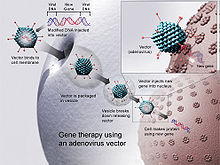
In order to replicate, viruses introduce their genetic material into the host cell, tricking the host's cellular machinery into using it as blueprints for viral proteins. Retroviruses go a stage further by having their genetic material copied into the genome of the host cell. Scientists exploit this by substituting a virus's genetic material with therapeutic DNA. (The term 'DNA' may be an oversimplification, as some viruses contain RNA, and gene therapy could take this form as well.) A number of viruses have been used for human gene therapy, including retroviruses, adenoviruses, herpes simplex, vaccinia, and adeno-associated virus.[4] Like the genetic material (DNA or RNA) in viruses, therapeutic DNA can be designed to simply serve as a temporary blueprint that is degraded naturally or (at least theoretically) to enter the host's genome, becoming a permanent part of the host's DNA in infected cells.
Non-viral
Non-viral vectors for gene therapy[56] present certain advantages over viral methods, such as large scale production and low host immunogenicity. However, non-viral methods initially produced lower levels of transfection and gene expression, and thus lower therapeutic efficacy. Newer technologies offer promise of solving these problems, with the advent of increased cell-specific targeting and subcellular trafficking control.
Methods for non-viral gene therapy include the injection of naked DNA, electroporation, the gene gun, sonoporation, magnetofection, the use of oligonucleotides, lipoplexes, dendrimers, and inorganic nanoparticles.
More recent approaches, such as those performed by companies such as Ligandal, offer the possibility of creating cell-specific targeting technologies for a variety of gene therapy modalities, including RNA, DNA and gene editing tools such as CRISPR. Other companies, such as Arbutus Biopharma and Arcturus Therapeutics, offer non-viral, non-cell-targeted approaches that mainly exhibit liver trophism. In more recent years, startups such as Sixfold Bio, GenEdit, and Spotlight Therapeutics have begun to solve the non-viral gene delivery problem. Non-viral techniques offer the possibility of repeat dosing and greater tailorability of genetic payloads, which in the future will be more likely to take over viral-based delivery systems.
Companies such as Editas Medicine, Intellia Therapeutics, CRISPR Therapeutics, Casebia, Cellectis, Precision Biosciences, bluebird bio, and Sangamo have developed non-viral gene editing techniques, however frequently still use viruses for delivering gene insertion material following genomic cleavage by guided nucleases. These companies focus on gene editing, and still face major delivery hurdles.
BioNTech, Moderna Therapeutics and CureVac focus on delivery of mRNA payloads, which are necessarily non-viral delivery problems.
Alnylam, Dicerna Pharmaceuticals, and Ionis Pharmaceuticals focus on delivery of siRNA (antisense oligonucleotides) for gene suppression, which also necessitate non-viral delivery systems.
In academic contexts, a number of laboratories are working on delivery of PEGylated particles, which form serum protein coronas and chiefly exhibit LDL receptor mediated uptake in cells in vivo.[57]
In vivo versus ex vivo therapies
In in vivo gene therapy, a vector (typically, a virus) is introduced to the patient, which then achieves the desired biological effect by passing the genetic material (e.g. for a missing protein) into the patient's cells. In ex vivo gene therapies, such as CAR-T therapeutics, the patient's own cells (autologous) or healthy donor cells (allogeneic) are modified outside the body (hence, ex vivo) using a vector to express a particular protein, such as a chimeric antigen receptor.[58]
In vivo gene therapy is seen as simpler, since it does not require the harvesting of mitotic cells. However, ex vivo gene therapies are better tolerated and less associated with severe immune responses.[59] The death of Jesse Gelsinger in a trial of an adenovirus-vectored treatment for ornithine transcarbamylase deficiency due to a systemic inflammatory reaction led to a temporary halt on gene therapy trials across the United States.[60] As of 2021, in vivo and ex vivo therapeutics are both seen as safe.[61]
Gene doping
Athletes may adopt gene therapy technologies to improve their performance.[62] Gene doping is not known to occur, but multiple gene therapies may have such effects. Kayser et al. argue that gene doping could level the playing field if all athletes receive equal access. Critics claim that any therapeutic intervention for non-therapeutic/enhancement purposes compromises the ethical foundations of medicine and sports.[63]
Human genetic engineering
Genetic engineering could be used to cure diseases, but also to change physical appearance, metabolism, and even improve physical capabilities and mental faculties such as memory and intelligence. Ethical claims about germline engineering include beliefs that every fetus has a right to remain genetically unmodified, that parents hold the right to genetically modify their offspring, and that every child has the right to be born free of preventable diseases.[64][65][66] For parents, genetic engineering could be seen as another child enhancement technique to add to diet, exercise, education, training, cosmetics, and plastic surgery.[67][68] Another theorist claims that moral concerns limit but do not prohibit germline engineering.[69]
A recent issue of the journal Bioethics was devoted to moral issues surrounding germline genetic engineering in people.[70]
Possible regulatory schemes include a complete ban, provision to everyone, or professional self-regulation. The American Medical Association's Council on Ethical and Judicial Affairs stated that "genetic interventions to enhance traits should be considered permissible only in severely restricted situations: (1) clear and meaningful benefits to the fetus or child; (2) no trade-off with other characteristics or traits; and (3) equal access to the genetic technology, irrespective of income or other socioeconomic characteristics."[71]
As early in the history of biotechnology as 1990, there have been scientists opposed to attempts to modify the human germline using these new tools,[72] and such concerns have continued as technology progressed.[73][74] With the advent of new techniques like CRISPR, in March 2015 a group of scientists urged a worldwide moratorium on clinical use of gene editing technologies to edit the human genome in a way that can be inherited.[75][76][77][78] In April 2015, researchers sparked controversy when they reported results of basic research to edit the DNA of non-viable human embryos using CRISPR.[79][80] A committee of the American National Academy of Sciences and National Academy of Medicine gave qualified support to human genome editing in 2017[81][82] once answers have been found to safety and efficiency problems "but only for serious conditions under stringent oversight."[83]
Treatment of genetic diseases
Gene therapy approaches to replace a faulty gene with a healthy gene have been proposed and are being studied for treating some genetic diseases. Diseases such as sickle cell disease that are caused by autosomal recessive disorders for which a person's normal phenotype or cell function may be restored in cells that have the disease by a normal copy of the gene that is mutated, may be a good candidate for gene therapy treatment.[84][85] The risks and benefits related to gene therapy for sickle cell disease are not known.[85]
List of gene therapies for treatment of disease
Some genetic therapies have been approved by the U.S. Food and Drug Administration (FDA), the European Medicines Agency (EMA), and for use in Russia and China.
Adverse effects, contraindications and hurdles for use
Some of the unsolved problems include:
- Short-lived nature – Before gene therapy can become a permanent cure for a condition, the therapeutic DNA introduced into target cells must remain functional and the cells containing the therapeutic DNA must be stable. Problems with integrating therapeutic DNA into the genome and the rapidly dividing nature of many cells prevent it from achieving long-term benefits. Patients require multiple treatments.
- Immune response – Any time a foreign object is introduced into human tissues, the immune system is stimulated to attack the invader. Stimulating the immune system in a way that reduces gene therapy effectiveness is possible. The immune system's enhanced response to viruses that it has seen before reduces the effectiveness to repeated treatments.
- Problems with viral vectors – Viral vectors carry the risks of toxicity, inflammatory responses, and gene control and targeting issues.
- Multigene disorders – Some commonly occurring disorders, such as heart disease, high blood pressure, Alzheimer's disease, arthritis, and diabetes, are affected by variations in multiple genes, which complicate gene therapy.
- Some therapies may breach the Weismann barrier (between soma and germ-line) protecting the testes, potentially modifying the germline, falling afoul of regulations in countries that prohibit the latter practice.[98]
- Insertional mutagenesis – If the DNA is integrated in a sensitive spot in the genome, for example in a tumor suppressor gene, the therapy could induce a tumor. This has occurred in clinical trials for X-linked severe combined immunodeficiency (X-SCID) patients, in which hematopoietic stem cells were transduced with a corrective transgene using a retrovirus, and this led to the development of T cell leukemia in 3 of 20 patients.[99][100] One possible solution is to add a functional tumor suppressor gene to the DNA to be integrated. This may be problematic since the longer the DNA is, the harder it is to integrate into cell genomes.[101] CRISPR technology allows researchers to make much more precise genome changes at exact locations.[102]
- Cost – Alipogene tiparvovec or Glybera, for example, at a cost of $1.6 million per patient, was reported in 2013, to be the world's most expensive drug.[103][104]
Deaths
Three patients' deaths have been reported in gene therapy trials, putting the field under close scrutiny. The first was that of Jesse Gelsinger, who died in 1999, because of immune rejection response.[105][106] One X-SCID patient died of leukemia in 2003.[17] In 2007, a rheumatoid arthritis patient died from an infection; the subsequent investigation concluded that the death was not related to gene therapy.[107]
Regulations
Regulations covering genetic modification are part of general guidelines about human-involved biomedical research.[citation needed] There are no international treaties which are legally binding in this area, but there are recommendations for national laws from various bodies.[citation needed]
The Helsinki Declaration (Ethical Principles for Medical Research Involving Human Subjects) was amended by the World Medical Association's General Assembly in 2008. This document provides principles physicians and researchers must consider when involving humans as research subjects. The Statement on Gene Therapy Research initiated by the Human Genome Organization (HUGO) in 2001, provides a legal baseline for all countries. HUGO's document emphasizes human freedom and adherence to human rights, and offers recommendations for somatic gene therapy, including the importance of recognizing public concerns about such research.[108]
United States
No federal legislation lays out protocols or restrictions about human genetic engineering. This subject is governed by overlapping regulations from local and federal agencies, including the Department of Health and Human Services, the FDA and NIH's Recombinant DNA Advisory Committee. Researchers seeking federal funds for an investigational new drug application, (commonly the case for somatic human genetic engineering,) must obey international and federal guidelines for the protection of human subjects.[109]
NIH serves as the main gene therapy regulator for federally funded research. Privately funded research is advised to follow these regulations. NIH provides funding for research that develops or enhances genetic engineering techniques and to evaluate the ethics and quality in current research. The NIH maintains a mandatory registry of human genetic engineering research protocols that includes all federally funded projects.[110]
An NIH advisory committee published a set of guidelines on gene manipulation.[111] The guidelines discuss lab safety as well as human test subjects and various experimental types that involve genetic changes. Several sections specifically pertain to human genetic engineering, including Section III-C-1. This section describes required review processes and other aspects when seeking approval to begin clinical research involving genetic transfer into a human patient.[112] The protocol for a gene therapy clinical trial must be approved by the NIH's Recombinant DNA Advisory Committee prior to any clinical trial beginning; this is different from any other kind of clinical trial.[111]
As with other kinds of drugs, the FDA regulates the quality and safety of gene therapy products and supervises how these products are used clinically. Therapeutic alteration of the human genome falls under the same regulatory requirements as any other medical treatment. Research involving human subjects, such as clinical trials, must be reviewed and approved by the FDA and an Institutional Review Board.[113][114]